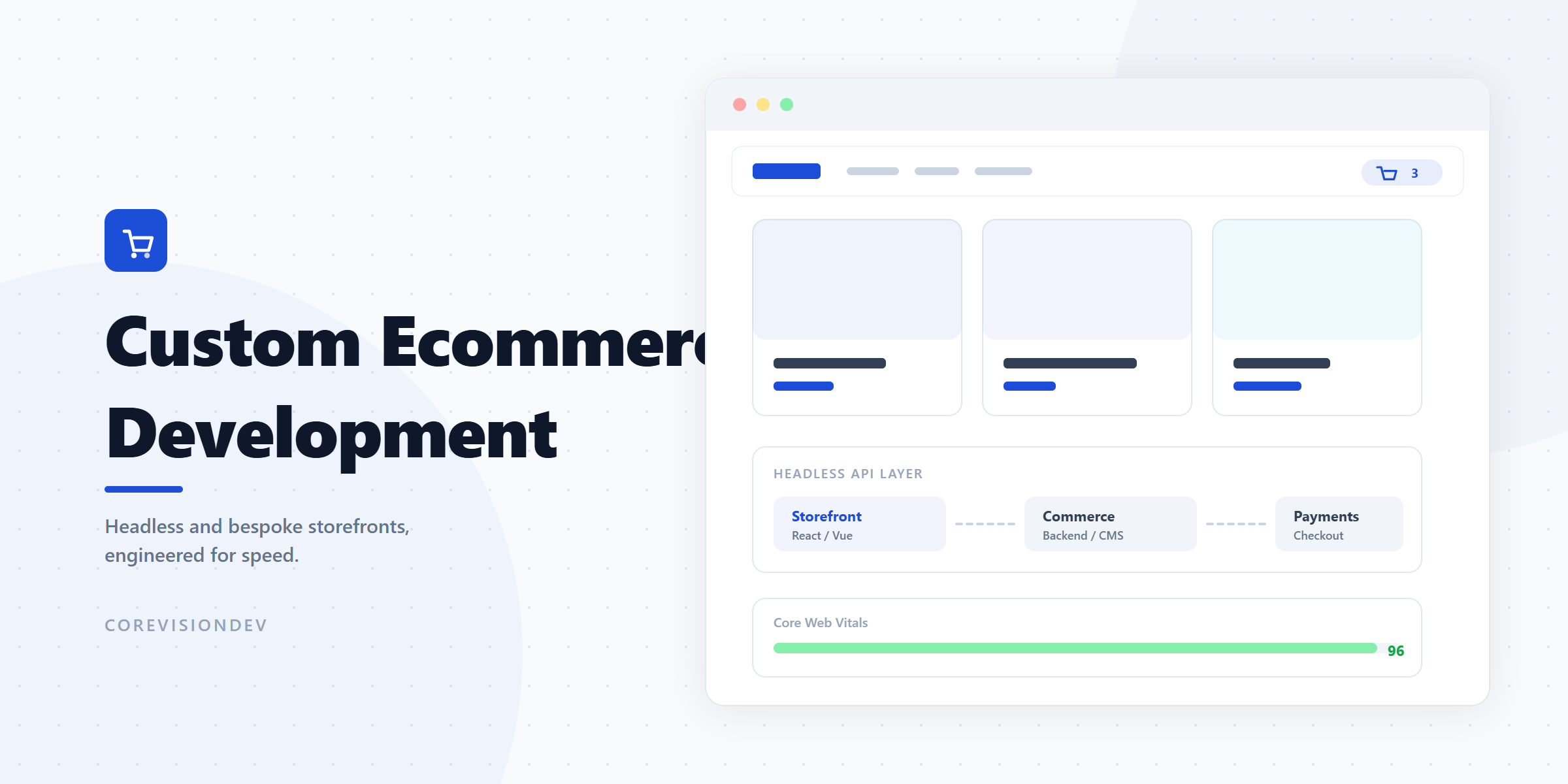
When You Need Custom Ecommerce Instead of a Template
Templates are the right choice for a lot of stores. If you are early, testing a market, or selling a small catalogue, a well-configured theme will serve you fine, and we will tell you so.
Custom ecommerce becomes the right choice when the template starts costing you more than it saves. That happens in a few recognisable ways. The checkout flow you need is not the one the platform allows. Your store is slow and you cannot fix it because the theme controls the performance. Your brand experience is constrained to what the template supports, so your store looks and behaves like every competitor on the same platform. Or you are expanding into a market, like Arabic-language RTL commerce, that off-the-shelf themes handle badly or not at all.
At that point a custom build stops being a luxury and starts being the thing standing between you and the next stage of growth. The question is not whether custom costs more than a template. It is whether the template is now costing you sales.
What We Build
Headless ecommerce storefronts
Custom frontends in React, Vue, or Next.js connected to a commerce backend through APIs. Full design and performance control on the frontend, with the backend still handling checkout, inventory, and fulfilment. The approach that gives you a bespoke experience without rebuilding commerce infrastructure from scratch.
Fully custom online stores
Bespoke ecommerce built from the ground up for businesses whose requirements do not fit any platform. Complete control over every part of the store, from catalogue architecture to checkout.
Performance-engineered storefronts
Stores built for speed because most ecommerce happens on mobile and slow stores lose sales. Core Web Vitals, load time, and mobile responsiveness are engineering priorities from the start, not fixes applied when conversions drop.
Payment and commerce integrations
Secure integration of payment processors, commerce backends, headless CMS platforms, and the third-party services a store depends on. Our team has built payment and third-party integrations across multiple products.
Product catalogue and content architecture
Catalogue structures and content architectures, often through a headless CMS, that let you manage products and content without touching the store code or waiting on a deployment.
Multilingual and RTL ecommerce
Native capability across English, Arabic, French, and German, including full RTL support for Arabic-language stores. Proper bidirectional layouts and RTL-aware components, built by people who read the language, for MENA markets most ecommerce agencies do not serve properly.
The storefront work is built by our frontend developers in React or Vue, while payment and commerce backend connections are handled by our API developers.
The Ecommerce Experience Behind This
We want to be straight about our track record.
We have not shipped a store branded as an ecommerce case study, but the technical foundations of a modern custom store are foundations we have built repeatedly. We build fast, custom frontends in React and Vue, which is exactly what a headless storefront is. We have built headless architectures where a custom frontend pulls content from a backend through APIs, most directly on Senaei, a national-scale platform running a headless CMS through Directus. We have built payment-adjacent and third-party integrations, secure API layers, and multilingual RTL interfaces, all of which are core to a custom ecommerce build.
A custom or headless store is an assembly of these same foundations: a fast custom frontend, an API-connected backend, secure integrations, and performance engineering. That is the work we do. When you build a custom store with us, you are getting a team that has built the underlying architecture before, not one learning it on your budget.
We are precise about this because a team that claims an ecommerce track record it does not have is the kind of team that ships you a slow store and disappears.
How the Process Works
Free strategy call
You tell us about your brand, your current store, and where the template or platform is holding you back. We ask the questions that matter and tell you honestly whether custom is the right move or whether a template would still serve you.
3-month roadmap
Before any code gets written, we define priorities, architecture decisions, and deliverables for the first three months. You know exactly what you are getting and when.
Sprints, daily standups, continuous builds
Developers build in sprints. Daily standups keep you informed. Nothing ships without your visibility into what changed and why.
Bi-weekly demos and continuous deployment
Every two weeks you see real, working features in the deployed store. Feedback goes in immediately.
Launch and ongoing management
Your store goes live. We stay embedded. Performance monitoring, catalogue and feature work, bug fixes, and iteration continue as part of the normal work cycle.
CoreVisionDev vs a Template Build or a Freelancer
| Feature | CoreVisionDev | Template build | Freelance platform |
|---|---|---|---|
| Time to start | 5 days | Fast but limited | 1 to 4 weeks |
| Custom storefront, no template limits | Depends | ||
| Headless architecture capability | Rare | ||
| Performance engineered from the start | Constrained by theme | Depends | |
| Payment and third-party integration | Limited to platform apps | Depends | |
| RTL and multilingual ecommerce | Rare | Rare | |
| Dedicated project manager | |||
| Ongoing development after launch | |||
| Full code ownership | Platform-locked | Variable |
A template build is fast and cheap, and for the right store it is the correct choice. But it locks you into the platform’s limits on design, performance, and checkout, and you never truly own the store, you rent it within the platform’s rules. A freelancer can build custom but leaves you managing them with no continuity and no one accountable once the store is live. CoreVisionDev gives you a managed team that builds a bespoke or headless store you fully own, engineered for performance, and stays embedded to develop it as the business grows.
On every specific point in that comparison: CoreVisionDev gets a team inside your project in 5 days. You get a custom storefront free of template constraints, with headless architecture capability that a theme build cannot offer. Performance is engineered from the start rather than capped by a theme. Payment and third-party integrations go beyond the platform’s app store. RTL and multilingual ecommerce is native to our team. You get a dedicated project manager and ongoing development after launch. Full code ownership transfers to you, rather than being locked inside a platform.
Who This Works For
CoreVisionDev is the right choice if you are:
- A brand that has outgrown a template store and needs custom design, performance, or checkout the platform cannot deliver
- A founder who wants a headless build: a fast custom storefront connected to a commerce backend
- A store expanding into Arabic, French, or German markets that needs proper multilingual and RTL ecommerce, not a translation layer on an LTR theme
- A business that wants a team to build the store and stay to develop it, not a one-time build with no support
CoreVisionDev is not the right fit if you are:
- Early stage with a small catalogue and no custom requirements. A well-configured template will serve you better and cheaper, and we will tell you so.
- Looking for the cheapest option available. We do not compete on price.
- Looking to make every technical decision yourself without a partner
Quality Standards
Every component is reviewed by a senior team lead before it ships. QA testing runs on every sprint delivery across browsers, devices, and mobile, where most ecommerce traffic is. Performance and Core Web Vitals are checked on every release. Security practices are applied to payment flows and the application layer. AI tools are part of how we work, but a developer reviews every output before it gets committed. If a developer is not the right fit for your product, we replace them at no cost. We sign an NDA before any work begins and full code ownership transfers to you.